


We stock Aluminium and Brass sections in a huge range of forms and shapes – the majority of which have imperial dimensions.
Imperial measurements (Feet, Inches, Eighths and Sixteenths of Inches) can often prove confusing for the layman. The main reason behind this is that the Metric system has been the primary system of measurement that is taught in British schools since 1974. Therefore, unless you are of a certain age, or your day job involves working with imperial measurements then there is a good chance that ordering Aluminium Tubes and Bars that are sized in inches is a daunting prospect.
In Aluminium and in Brass imperial sized sections such as Angles, Channels, Tubes, Bars and Tee Sections are still more common and therefore are often cheaper than metric sizes. Of course, some applications demand that the size of material needs to be exact, but in many cases an approximate size is perfectly acceptable. In almost every instance there is an imperial sized profile that matches up to, or at least comes very close to standard nominal metric dimensions. For example ¼” (or 0.25”) converted to metric is 6.35mm. 5/8” (0.625”) is 15.9mm and 1” converts to 25.4mm.
For ease of use we list all our Aluminium and Brass sections in both metric and imperial dimensions. For a full list of conversions please see the table below.
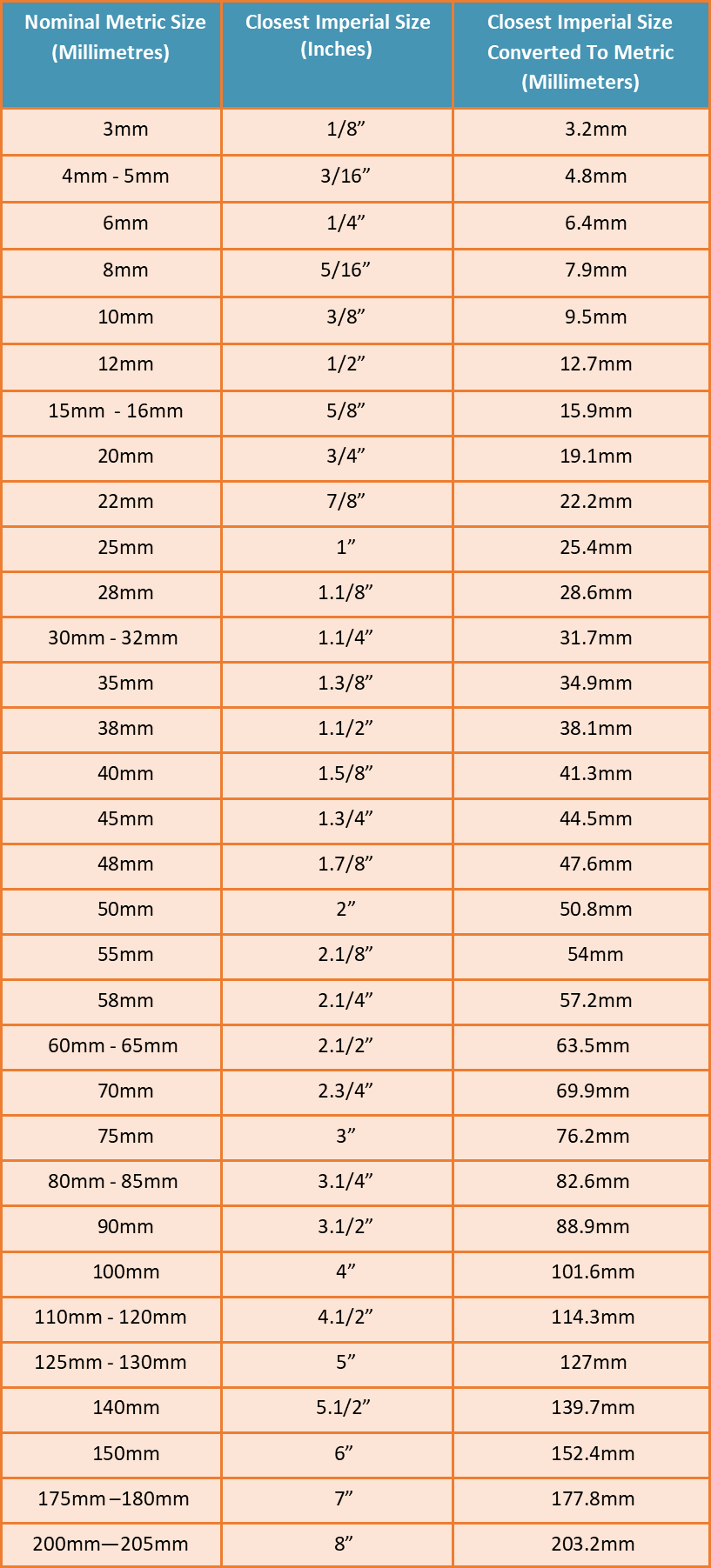
Understanding Imperial and Metric Metal Sizes
Imperial metal sizes are based on inches, while metric metal sizes are based on millimetres.
As explained above, many aluminium and brass sections are listed using imperial dimensions. This means the converted metric size may be close to a standard metric measurement without being exactly the same.
For example:
-
1/4” converts to 6.35mm
-
5/8” converts to 15.9mm
-
1” converts to 25.4mm
When comparing sizes, it is important to check the actual converted dimension rather than assuming that an imperial size is exactly the same as a nominal metric size.
If you are looking for material in different forms, you can browse our Aluminium Tube & Box Section, Aluminium Round, Flat and Square Bars, Brass Angles and Brass Round Tubes ranges.
Checking the Size You Need
Some applications require a close dimensional match, so it is important to compare the required size with the actual converted measurement shown on the product or sizing information.
This is particularly important where:
-
The material needs to match an existing section
-
The size must fit within a set opening
-
Internal or external dimensions are important
-
The material is being used alongside other components
Where exact size matters, checking the measurement before ordering can help avoid mistakes.
Cut to Length Options
If you need material supplied at a specific length, our Free Cutting Service provides one free cut per line item purchased.
If you are unsure which size is most suitable for your application, you can also contact us before ordering.
Frequently Asked Questions
What is the difference between imperial and metric metal sizes?
Imperial metal sizes are measured in inches, while metric metal sizes are measured in millimetres.
Why do some metal sizes not convert exactly into whole millimetres?
Imperial sizes convert into metric measurements using fixed values, so the result is often a decimal measurement rather than a whole number.
Why are aluminium and brass sections sometimes listed in inches?
This page explains that many aluminium and brass sections are available with imperial dimensions, with metric conversions shown alongside them.
How do I compare an imperial metal size with a metric size?
The simplest way is to check the converted metric measurement and compare it with the size required for your application.
When should I check the exact converted size?
It is important to check the exact converted size when a section needs to match, fit precisely, or work with other components.
If you are unsure which size you need, please contact us for advice, or browse our aluminium and brass ranges to compare available section sizes.

Trade Account
Credit accounts & discounts area available. Simply get in tocuh and speak to us directly.

Free Cutting Service
1 x Free Cut - per line item purchased - receive the item at the exact length required for the job

Folding Service
We are able to offer our Aluminium Sheets & Chequer Plates and Stainless Steel Sheets folded to the customers specifications
We accept all types of credit and debit cards.
